AI in the fashion industry: what works in design today
AI in fashion industry speeds up concept generation but a concept still needs buildable pattern and fit validation before it becomes a production garment. That gap determines whether AI saves a season or costs one.
Design teams feel pressure to get AI image tools in place quickly and the first results look great. Then later on when a technical team gets a striking picture without seams, grainlines or fabric behavior behind it approvals restart samples multiply and early speed disappears.
This guide separates AI that generates images from AI that supports buildable fit-checked garments. Where each helps, where it doesn’t and what a design leader should check before adopting any tool.
Where AI in the fashion industry works today
AI in fashion design is software that generates, searches or analyzes designs from data and returns suggestions a designer accepts/rejects. Five uses stand out in current workflows:
- Concept generation. The designers describe a garment (in words or with reference images), then go over silhouettes, prints and colorways in one session.
- Search and reuse. Visual search finds styles by look even when metadata is incomplete so a team starts from work it already owns.
- Asset and prompt reuse. Teams save images, colors and prompts. Reuse them across whiteboards to keep exploration consistent.
- Fit review. Tools score tension and pressure maps on a digital garment and flag areas of concern for the pattern team.
- Model imagery. AI models bring an approved digital garment into product approval, wholesale and e-commerce visuals.
Each use speeds up one step. None of them decides whether a garment is ready to make or not.
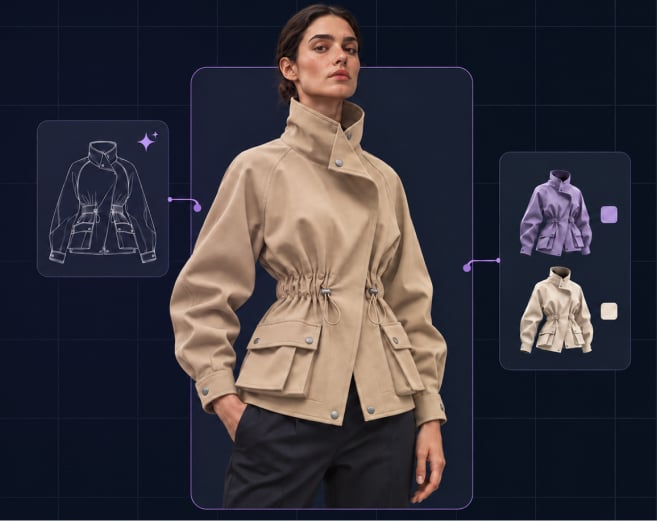
Concept generation shows how this works in practice. In the Browzwear Whiteboard a designer combines text prompt with up to eight reference images (sketches, fabric swatches, color references) and can generate still images or short animations. The results land on the canvas as ordinary objects that teammates move, resize, duplicate and delete. Designer is looped at every step; options are reviewed together in one shared space instead of scattered files.
Where AI concepts stop short of production
Image generators learn from pictures of finished garments. They copy silhouette, color and surface but they don’t carry seam placement, grainline direction, ease, closures or how a specific fabric drapes once a team cuts and sews it. A generated jacket looks complete but nothing underneath tells a factory how to build it.
A buildable garment is a style with pattern pieces, construction details and fabric behavior that a technical team can review and a factory can produce. An AI image is not a substitute for that style. It’s a starting point for the style. Making a picture into a pattern after the fact is reverse engineering and puts the delay in the design studio to technical team. Read from AI concepts to buildable patterns for more on this handoff.
The business cost for the brand design leader is concrete: more late changes, slower approvals and creative direction that shifts after the team has committed.
The problem grows with volume. If a team runs more concepts through AI earlier in the season then more of them make it to technical review. Each one needs the same construction data. Solving that once (when the concept enters development) is cheaper than solving it again for every idea that survives.
How AI works with 3D and patterns
The best workflow is where AI is fast and 3D development is precise. Concepts are on a shared canvas and the team reviews them there. Approved styles go into 3D pattern development (drape fabric, fit it on avatar, refine pattern). Finished digital garment goes to technical teams then merchandising visuals.
The following table shows how that division of work looks in Browzwear, based on the Browzwear help center:
| Stage |
What carries the work |
What the team still confirms |
Browzwear tool |
| Concept |
AI-generated visuals from prompts and reference images |
Which concepts deserve development |
Generate with AI on the Whiteboard in Stylezone |
| Selection |
AI visual match across existing styles |
Which style is the right starting point |
AI Match in Stylezone |
| Development |
Pattern pieces and fabric simulation |
Construction, drape, and fit |
VStitcher |
| Fit check |
Tension and pressure scoring, with optional AI written analysis |
Which pattern changes to make |
VS Fit QC plugin |
| Imagery |
AI models |
Accuracy against the approved digital garment |
AI Models |
Can an AI concept become a production-accurate garment? Yes it can, after pattern development, simulation and fit review have been done. The concept gives direction. Pattern gives instructions.
Browzwear says their AI tools support the designer not replace one. That’s how design leaders work already: AI widens options; people choose.
What to check before adopting AI tools
Use these five checks to compare any AI tool (not just Browzwear’s):
- Output type. Ask if the tool produces an image or a file with pattern and fabric data. Only the second one goes straight into development.
- Data handling. Ask where prompts, images and patterns go (and whether the vendor trains models on them). Browzwear’s help center says Stylezone AI tools run in a closed client-specific environment so inputs don’t train models or reach other clients. Some Browzwear plugins do not. They send data to an outside AI provider through your own API key. Read each plugin’s help article first.
- Licensing. Generate with AI requires an Enterprise or Teams plan (with AI Ideation entitlement) and plugins may need additional licensing too. Check what’s included in your plan.
- Ownership. Ask the vendor who owns the output and how it protects proprietary designs. Get that answer in writing before you expose brand assets.
- Review gates. Decide who approves AI output and when a concept must pass pattern and fit review.
Start small. Pick one collection or one capsule and run it through the whole path from concept to fit-checked digital garment and where the handoffs hold up and where they break down. That single pass shows a design leader what AI changes for the team and what it leaves untouched.
FAQ
What is AI in the fashion industry?
AI in fashion is software that generates designs, searches style libraries, scores fit and creates model imagery from data. It speeds up early steps but a concept still needs a buildable pattern and fit validation before production.
How do designers use AI in fashion design?
AI prompts and reference images are used to generate concepts (from prompts); similar existing styles are found; saved colors and prompts reused; fit is reviewed. Approved concepts then go into 3D pattern development for construction and fit validation.
Can AI replace fashion designers?
No. AI provides options, searches libraries and scores fit but the designer decides direction and approves results. Browzwear says its tools are “support for the designer not replacement.”
Can an AI design go straight into production?
Not directly. An image doesn’t have seams, grainlines or fabric behaviour. A team needs a pattern, fabric simulation and fit validation before the factory can build the garment.
Is AI safe for proprietary brand designs?
It depends on the tool. Ask where inputs go and if vendor trains on them (Browzwear says Stylezone AI tools run in closed, client-specific environment and do not train on client inputs).
How should a design team start with AI?
Start with concept generation and review on a whiteboard. Move approved styles into 3D pattern development, fit before any physical sample. Add other AI tools once you check data handling & licensing.
Key takeaways
- AI in the fashion industry speeds up concept generation but a concept still needs a buildable pattern and fit validation before production.
- An AI image has no seams, grainlines or fabric behaviour so it is not a production file. It works as a starting point only.
- AI helps most in five places: concepts, search, asset reuse, fit review and model imagery.
- Pattern pieces and fabric simulation make a concept buildable and fit review confirms it.
- Compare any AI tool on output type, data handling, licensing, ownership and review gates.
- Browzwear says Stylezone AI tools run in a closed client specific environment and some plugins send data to outside provider via your own key.
See the workflow in action
See how your design team can translate AI concepts into a fit-validated digital garment before your team cuts the physical sample.