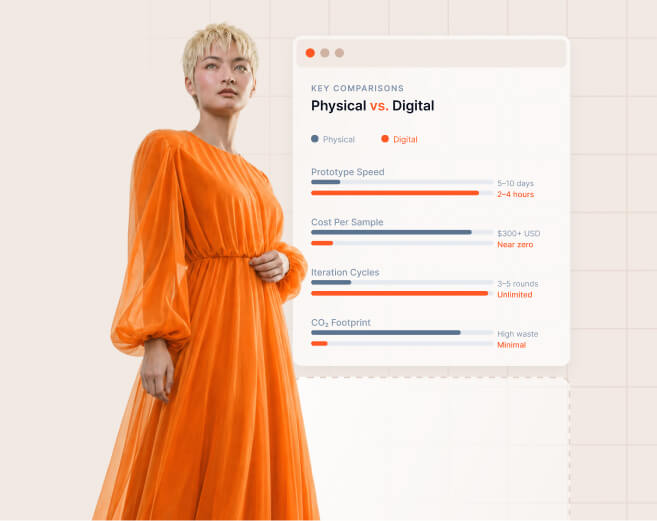
Digital draping vs. physical draping
Every design leader who works on four or more collections a year comes to the same decision: which drape can be trusted on screen and which one still needs to hang on a body in the sample room. Get the call wrong in one direction and a collection loses weeks to physical rework after buyers have already signed off. Get it wrong in the other direction and teams keep ordering samples a validated 3D workflow could have replaced. Digital drape simulation, when it’s based on measured fabric data, can accurately simulate how a garment moves and falls for design, fit, and buyer decisions, while physical draping is still the final check when supplier variation or contractual sign-off is on the line.
Why this decision keeps landing on your desk
Draping has always been a craft discipline: a fabric's hand, weight, and bias behavior only fully reveal themselves once it is on a form. That is still true. What has changed is the calendar. Three shifts have compressed the window design leaders have to make this call:
- Collection numbers have grown in recent years so each additional sampling round becomes part of the next season's timeline.
- Fabric behavior data can now be measured and applied digitally, closing much of the gap that made 3D a rough approximation rather than a working reference.
- Cross-functional teams want to review and approve in parallel, not wait for a physical drape to travel between design, merchandising, and production.
Brands using Browzwear report reducing time-to-market by 30 to 50 percent, and a global sportswear brand using the platform reduced physical samples by 60 percent. They do not gain from removing physical draping. They gain from being precise about where it still earns its place.
The stage-by-stage trade-off
A digital drape and a physical drape answer different questions well. The table below shows five stages of development, what a fabric-accurate digital drape resolves at each one, and where a physical drape still holds the final word.
Digital drape vs. physical drape by development stage
| Development stage |
What digital drape resolves |
Where physical draping still leads |
| Concept and early exploration |
Silhouette, proportion, and volume of fabric weights without cutting a single yard |
New, unmeasured fabrics with no digital profile yet on file |
| First fit and proportion review |
Drape, fall, and ease on a graded avatar set to have early design conversations |
Bias-cut or asymmetric constructions where hand-feel is the driving force for cutting decisions |
| Fabric and colorway validation |
Side-by-side comparison of colorways and finishes on the same base construction |
Fabrics with high lot-to-lot variation like natural fibers and specialty knits |
| Cross-functional and buyer approval |
Parallel review of design, merchandising, and production on one shared digital twin |
Buyer requirements that contractually require a physical hand or final approval sample |
| Pre-production and final sign-off |
Confirmation that construction and grading match the approved digital reference |
Final physical check against supplier-specific machinery, trims, and finishing |
The pattern holds across stages: digital draping earns the call when the behavior of the fabric is already known, and the decision is about design, proportion, or communication. Physical draping earns the call wherever a new fabric, a contractual requirement, or supplier-specific variation is still unresolved.
Turning fabric-accurate simulation into fewer, better-placed drapes
Browzwear capabilities mapped to operational change and business outcome
| Browzwear capability |
Operational change |
Business outcome for design leaders |
| Fabric Analyzer measurement of stiffness, shear, drape, weight, and thickness |
Physical fabric properties are digitized once and reused across every style built from that fabric |
Digital drape decisions are made on the basis of measured data and not visual approximation |
| VStitcher physics-based simulation for woven, knit, and non-woven construction |
Drape, fall, and movement are simulated under gravity and motion, not rendered as a static image |
Design and fit discussions occur on a garment that behaves like the physical version |
| Shared digital twin across design, merchandising, and production |
Stakeholders review the same fabric-accurate file instead of separate physical samples |
Fewer sequential handoffs and fewer late-stage surprises at buyer review |
| Colorway and construction comparison within one file |
Multiple fabric and color options are evaluated side by side before cutting |
Fewer exploratory physical samples per style during early development |
Where the decision fits in the workflow
A fabric-accurate digital drape starts the moment a fabric is measured through Fabric Analyzer, not the moment a designer opens a 3D tool. That sequencing matters: a digital drape is only as reliable as the fabric data behind it. Once a fabric is measured, VStitcher applies that data to simulate how the garment falls, stretches, and moves on a graded avatar, which is why early design and fit review can happen without a physical sample.
From there, the digital twin moves into StyleZone where merchandising, production, and buying teams review the same file instead of waiting for a physical sample to circulate. This is where much of the calendar gain in the table above is realized because parallel review replaces sequential physical handoffs. The digital file does not need to replace every physical checkpoint to deliver that gain. It only needs to replace the checkpoints where the fabric behavior is already known.
Physical draping re-enters the workflow intentionally and not automatically at the stages that the table points out: unmeasured fabrics, high-variation materials, and any point where a supplier or buyer contract requires a physical hand. Design leaders who treat this as a fixed checklist, rather than a one-time policy decision, get the calendar benefit without losing the fabric behavior accuracy that physical draping still protects.
What a fabric-accurate digital drape does not try to replace
Some approaches to 3D treat all stages the same way, and will force digital drape into decisions it is not built for: final approval on a fabric with lot variation or a contractual physical sign-off. That creates the exact risk design leaders should be watching for: a digital drape that looks good on screen but does not hold up when it is sent to a supplier with different equipment or a different fabric lot.
A fabric-accurate approach follows a less convenient and more defensible line. It resolves what measured fabric data can resolve, and it leaves physical draping in place wherever fabric variation, contractual requirement, or supplier-specific behavior is still an open question. That distinction is what separates a genuinely reliable substitute for hands-on testing from a shortcut that shifts risk downstream.
Addressing the real objection
The most common hesitation design leaders raise is not about workflow. It is trust: whether digital draping is a reliable substitute for hands-on fabric testing or a marketing claim that has not yet been tested against their own fabrics. That skepticism is fair. Simulation is only as accurate as the fabric data behind it, and a digital drape based on estimated or default fabric values will not stand up against a physical check. The answer is not a bigger claim. It is a narrower one: fabric-accurate simulation, measured through Fabric Analyzer and applied in VStitcher, is reliable for the stages in the table above for which the behavior of the fabric is well known, and it is not positioned as an alternative to physical draping at the stages where it is not. Design leaders do not need to trust digital draping everywhere to get most of the calendar benefit. They need to trust it where the fabric data supports it and keep physical draping where it does not.
A second concern worth addressing directly is whether design and technical teams will accept a digital-first call at all. Adoption goes further if it is documented stage by stage, as in the table above, rather than left to an individual judgment call by call. Teams trust a rule that they know is followed consistently more than a general recommendation to trust the 3D.
Frequently asked questions
What is the difference between digital draping and physical draping?
Digital draping simulates how a fabric moves and falls using measured fabric data. Physical draping tests the same behavior by hand, on a real body or form, with the actual fabric.
Is digital drape simulation accurate enough to replace physical draping?
For fabrics with measured properties, yes, at design, fit, and buyer review stages. For new or high-variation fabrics and contractual sign-off, physical draping is still necessary.
How does Browzwear measure fabric behavior for digital draping?
Fabric Analyzer measures physical properties such as stiffness, shear, drape, weight, and thickness, and applies that profile in VStitcher's simulation engine.
Which development stages benefit most from digital draping?
Concept exploration, first fit and proportion review, colorway comparison, and cross-functional approval, where the behavior of the fabric is already measured.
When should a design leader still require a physical drape?
When the fabric is new and unmeasured, has high lot-to-lot variation, or a buyer or supplier contract requires a physical sample for final sign-off.
Does digital draping mean giving up physical draping entirely?
No. Fabric-accurate simulation is designed to reduce which stages need a physical drape, not to eliminate physical draping as a practice.
Key takeaways
- Digital drape simulation, based on measured fabric data, is reliable for design, fit, and buyer decisions, not a universal substitute for physical draping.
- The stage of development, not a blanket policy, should determine whether a digital or physical drape is used.
- New or unmeasured fabrics, high-variation materials, and contractual sign-off points still require a physical drape.
- Fabric Analyzer measurement is the step that makes a digital drape trustworthy; simulation without measured data is where digital draping earns its skepticism.
- Brands using Browzwear report reducing time-to-market by 30 to 50 percent by applying this stage-by-stage approach, not by removing physical draping.
- A documented, stage-by-stage decision framework drives faster team adoption than a general instruction to trust 3D.