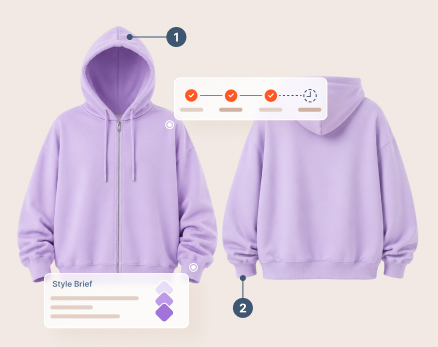
To say that range confirmation is a logistics issue would be wrong. But in the eyes of most buying teams, it is physical samples being shipped from vendor to vendor, review cycles dragging on, and sign-off meetings that can never take place until the right garment is in the right room. Every last week spent chasing at-scale samples takes away from addressing markdown pressure, addressing assortment gaps, or responding to a competitor who moved first.
Why the Physical Sample Review Cycle Breaks Down at Scale
Retailers that enable cross-vendor digital review capacity to verify ranges in fewer iterations, with buying teams involved earlier and vendor alignment emerging before it becomes a cost. But to arrive at that conclusion, you have to know why the traditional process does not scale with the numbers we are collecting.
The root issue is dependency. Traditional range sign-off is only possible if samples exist as physical proof. And for a buying team that has 10 or more vendors spread across a seasonal range, that dependency multiplies quickly. Each vendor has its own development schedule. Different portions of the calendar are the places where samples end up. Review sessions are scheduled, rescheduled, or squeezed into sprint periods that also permit little time for fit discussion, colorway difference comparison, or range coherence evaluation.
Multi-vendor retailers usually spend eight to 12 weeks on range confirmation per season - and every year this window shrinks as buying calendars compress. Digital sample review eliminates the physical bottleneck that makes it so complex.
The Digital Sample Review Playbook: Six Steps to Faster Range Sign-Off
Step 1: Establish a Digital File Standard Across Your Vendor Base
Before a single digital sample enters review, specify which file standard all vendors must adhere to for it to be added to the sample list. Specify the expectation in the vendor brief: digital files that are production-validated, include accurate fabric simulation, and show the confirmed colorways. Vendors who cannot hit the mark in round one should submit physical samples as a fallback, flagged for onboarding support. It's the clarity at the start of a process that divides the vendors willing to move at a digital pace from those who need a route to do so.
Step 2: Build a Shared Digital Review Environment
And only speed up sign-off when you share digital samples so the whole buying team can review them and pass judgment in the same location. A shared review environment - open to buyers, merchandising leads, and applicable product stakeholders - supplants the sample rail and the showroom visit. Styles appear side by side. Colorways toggle. Range-level assortment gaps become visible. The conversation changes from "when does the sample show up?" to "Does this fit into the range?"
Step 3: Run Vendor Alignment Before the Internal Review
Traditional range sign-off involves vendor corrections and internal review in a series of consecutive steps: review samples, identify issues, wait for revised samples, and review again. Digital review breaks such a sequence. Flag fit or finish items in the digital file, return to the vendor with annotated feedback, and be notified of corrected digital changes within days. Internal review then begins with vendors who have issues solved - not brought to the attention of the buying director.
Step 4: Align Buying Team Sign-Off Around Digital Assets
And for digital samples, this leads to structured, documented sign-offs unlike on-site signatures. Each style also has a version history - with what it changed, when, and according to what feedback. Sign-off decisions will be tied to a specific digital state of the product. For buying teams with cross-border stakeholders, the difference between a three-day review cycle and a three-week cycle is significant.
Step 5: Use Digital Range Views to Finalize Assortment Decisions
Range sign-off is a collection decision, not a style-by-style one. Put everything you've confirmed in one spot, search for categories, colors, or price points, and check whether the range fits before putting your hands on things. Gaps emerge ahead of the initial buy. Redundancies appear before an OTB is committed. Assortment planning no longer becomes reactive: rather than reactionary after the physical samples show what should have been caught earlier, it is proactive, not reactive.
Step 6: Document Sign-Off for Production Handoff
The final step combines the digital review outcome with production to create a production record. Styles checked off before approval, colorways approved, and any relevant sign-offs checked off once confirmed, are recorded against the digital file state. Vendors receive a production brief tied to the approved digital production version, limiting misinterpretations at the factory level and reducing revision cycles.
From Capability to Calendar: What Changes for Buying Teams
| Browzwear Capability |
Operational Change |
Business Outcome |
| Cross-vendor digital review environment |
The buying teams review styles from multiple vendors on a shared view, with no waits for physical samples to be sent out |
Range confirmation rounds reduced from four to six physical reviews to one to two digital sessions |
| Production-validated digital samples |
Fit and finish issues are identified and corrected at the vendor level prior to the commencement of internal review |
Fewer surprises at the buy stage; late-stage range changes drop across the season |
| Side-by-side style and colorway comparison |
Assortment decisions are made at the range level, not style by style, with full visibility across vendor submissions |
Stronger range coherence; redundant styles identified and removed prior to OTB commitment |
| Annotated digital feedback loops |
Vendor correction cycles are timed to ongoing review instead of one after the other, post each round |
Vendor alignment time compresses by weeks per season; buying calendar pressure decreases |
| Version-tracked digital sign-off |
Digital sign-off decisions are linked to a documented digital state that can be accessed from every device, no matter where you are |
Distributed buying teams get aligned quicker; fewer sign-off disputes and production misinterpretation |
How Digital Range Review Works End to End
We start with the vendor brief phase. For commercial clients, digital file submission is one of the vendors' commercial obligations, so digital development is embedded in their timeline. Files come earlier on the buying calendar than physical samples ever could - that is because the development cycle for a digital sample is shorter and does not rely on material sourcing, sewing, or international shipping.
Once files reach the review environment, the buying team treats the range as if one version were in the review environment. Styles from multiple vendors are all available in a single browser. Category filters enable the team to transition from full-range views to focused views in a matter of seconds. Colorway options are arranged side-by-side rather than arriving at different points in the calendar. The team looks at the collection as a collection - a collection that determines the way the end customer will interact with it.
Browzwear's cross-vendor digital review functionality is aligned with those workflows and enables purchasing teams to gauge and compare styles without waiting for physical replicas to pass through multiple parties. Vendor feedback is solicited directly from the review system. Corrected files go back to the same interface. Integration with PLM solutions can direct the approved digital record into the product data environment, eliminating manual re-entry and version mismatches. The file the buying team approved is the one the factory will receive.
The Actual Cost of a "Good Enough" Digital Review
However, not all digital sample tools meet the needs of these buying team workflows with the same rigor. Some platforms are optimized for design visualization - to make renders that, while appearing striking in a screenshot, don't bear the production data that makes sign-off decisions dependable. The distinction is between a digital sample that is production-validated and one that is design-representative. Production-validated means the file is produced with sufficient fabric behavior, construction details, and colorway specifications coded in it, so factory users receive purchasing team approval. That standard is imperative for enterprise buying teams operating within large vendor networks. A digital review that pushes risk downstream rather than to the front end adds expense at the worst time of year.
The Vendor Consistency Question - and How to Answer It
The most common issue in digital range reviews is vendor consistency. When half the vendor base makes production-validated digital sample submissions and the other half a flat render or none at all, the buying team ends up managing a hybrid process - one based on digital review of a few styles but another using a physical one - and the calendar incentive goes away.
It is a legitimate concern, but it is an operational problem that can be solved. Begin with vendors who already use digital-first workflows - usually larger, more loyal partners. Build an internal business case with early-season results, develop a vendor performance benchmark, and gradually expand this digital requirement, providing a clear onboarding timeline with commercial incentives such as priority order allocation, extended lead-time windows, preferred vendor status, etc.
Browzwear facilitates this change by providing vendor-facing software for creating digital files that meet the buying team's standards. Not every vendor needs to be completely digital at launch, but over two to three seasons, we hope to create a trusted vendor network with a track record of success. When vendors review how few revision rounds they have, adoption spreads like wildfire.
Questions Buying Teams Ask Before Going Digital
- Q: What is digital sample review in retail buying?
- A: Digital sample review allows buyer's teams to confirm fitting, construction, and colorway accuracy of 3D digital garments before a final deal is made - taking calendar and geographic dependencies out of the sign-off process.
- Q: In practice, how does cross-vendor digital review function?
- A: Vendors submit production-validated digital files to a common environment. The buying team looks at styles from a variety of vendors side by side, issues annotated feedback, and tracks corrections in the same platform - without shipments of physical samples from supplier to vendor.
- Q: What are the range sign-off advantages for merchandising teams?
- A: Merchandising leaders get range-level visibility earlier in the calendar, fewer physical review rounds per season, and buy decisions are more directly aligned with evidence in a digital record - resulting in faster and more accurate signoff across the vendor portfolio.
- Q: What if not all our vendors are functioning digitally yet?
- A: Begin with digital-ready vendors and set internal milestones and requirements. The majority of buying teams achieve meaningful vendor coverage in two to three seasons with an effective onboarding process and a commercial incentive model.
Key Takeaways
- Retailers with cross-vendor digital review capability see ranges confirmed faster, and also with fewer physical review rounds due to the fact that these assessments no longer hinge on tangible samples traveling between parties.
- The six-step playbook - from file standard design through documented production handoff- provides buying teams with a structured, repeatable process, taking the place of a responsive, sample-driven sign-off cycle.
- Production-validated digital samples are not design renders. The difference defines digital sign-off as continuing through manufacturing, or as incurring correction costs downstream.
- Vendor consistency is an operational issue that can be solved. A phased business model - beginning with vendors that are ready to integrate with digital capabilities and ramping requirements up gradually - creates resilience in two to three seasons.
- Compatible range views on either side lead to proactive assortment decision making: holes and duplication appear before purchase is made, increasing consistency, reducing scope duplication, and protecting the OTB from problems with the range.
Witness Faster Range Sign-Off in Action
Retailers employing Browzwear are faster to ascertain the range, with fewer reviews by foot and cleaner vendor alignment at every step of the way. How it works for your buying calendar.