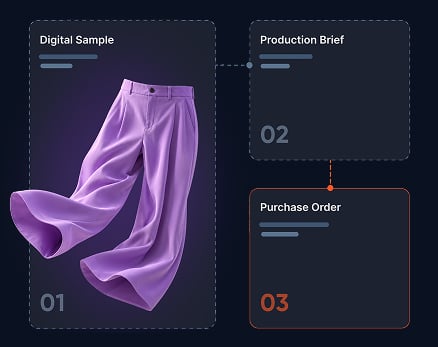
Some parts of the digital workflow have been solved by most apparel brands. Design teams design in 3D; production teams handle samples using PLM. And of course, buyers' reviews range in shared folders or slide decks. But what has been achieved at one stage disappears at the next handoff - because the tools, files, and decision logic don't travel together. Browzwear also uses end-to-end design and digital workflow to connect design, production, and commercial review in a single ecosystem, ensuring the validated digital twin created at concept holds pace at the production handoff and the retail buyer stage, with no rework at any stage.
Why Handoff Breaks the Workflow
And fragmentation is structural. Design, production, and merchandising operate under different cadences, on different systems, and with different standards for what constitutes "approved." A digital sample from the design team could have unresolved fit notes. A production-ready file may never see the buying team in a form they can sort through. A purchase order is placed against a physical sample that no longer matches the approved digital version. Each disconnection adds time: days waiting for a file to convert, a week for a physical sample to travel to a buyer, another round of revisions that might have been worked out in a single digital review. These gaps spread out over months across a four-collection calendar. Companies that digitize single processes and do not tie them together across the business don't make sure they're running a digital workflow - they're running a digital-adjacent one.
The Whole Process: Deciding what to add, where to add it, and what to remove
Browzwear organizes development within the product line as an iterative, interrelated series of decisions guided by validity logic, not a cascade of file downloads. Every effort results in an output that the next team can apply, without having to reinvent, reframe, or re-approve from scratch.
Stage 1 - Design and Virtual Prototyping
In VStitcher, designers create garments by analyzing fabric properties that mimic the properties of real materials. The result is a physical digital twin that performs with fit verified against calibrated avatars, prior to cutting a single physical sample. The Design Leaders confirm the silhouetted shape, colorway, and direction of the material, and don't wait to run a sample. Internal approvals are done against the digital twin. A file is held in Stylezone, where multiple stakeholders review it based on comments and approvals, and the decision on when to send the file is recorded. What once took three to five weeks of trial routing now takes days.
Stage 2 - Production Handoff
Once design sign-off is done, the validated digital twin is sent to production, ready with both technical data. Pattern geometry, grading requirements, material specifications, and fit validation data travel in the file - not as an alternate tech pack that may not capture the correct or approved version. First physical sample rounds are slashed or eliminated, since production begins with a validated baseline rather than a design interpretation.
Stage 3 - Commercial Review and Range Confirmation
All Buying and merchandising teams have access to the confirmed range through Stylezone prior to any physical samples being used. Looks can be categorized by category, colorway, and vendor allocation. Buyers match choices side by side and validate styles against range targets - all on the same digital assets design and production lines, already on the same page. And this is the corner where fragmented digital workflows tend to collapse. Browzwear manages all three teams on one file - the garment that a buyer affirms is the garment that production produces.
Stage 4 - Purchase Order Issuance
A purchase order is issued along with the digital record, which has already undergone design review, production validation, and commercial confirmation. Downstream variations are detected if they occur relative to a known baseline and are not absorbed quietly into manufacturing.
Capability to Outcome: What Changes at Each Stage
| Browzwear Capability |
Operational Change |
Business Outcome |
| Physics-based digital twin with validated fabric properties |
Design approvals happen against a production-accurate asset, not a render |
Fit and material decisions hold through manufacturing - late-stage corrections drop by 60-80% |
| Embedded technical data in the digital file |
Pattern, grading, and material specs transfer with the asset at every handoff |
First physical sample rounds reduced or eliminated; production starts from a validated baseline |
| Stylezone shared review environment |
Design, production, and buying teams review the same asset with a shared decision record |
Approval cycle time compressed from weeks to days; fewer rounds of re-review |
| Range presentation in Stylezone |
Buyers confirm styles digitally against the same files that production will use to manufacture |
Range confirmation accelerates; purchase orders are issued against a verified, consistent digital record |
| PLM and ERP integration via an open platform |
Digital workflow connects to existing systems without requiring parallel data entry |
Adoption scales across functions without replacing infrastructure; data integrity is maintained end to end |
How Browzwear Looks in the Current Stack
Browzwear is digital product documentation at the heart of your development cycle - not a substitute for PLM, ERP, or retail planning tools, but rather this is the layer that makes sure your product is in context, accurate, available, and actionable at every point in time. On the input side, Browzwear retrieves material data (stewards real material test data in physical fabric), connects to PLM systems where product structures are managed, and stores design files from the upstream ideation tools. On output, the digital twins are exported and validated to rendering pipelines, retail review platforms, and the systems of manufacturing partners. The purchase order is reported to the ERP without the need for reconciliation between the digital and commercial records. For Product Leaders assessing where Browzwear fits within the stack: it's the infrastructure where the product is developed, validated, and confirmed. All other systems refer to the product. It is where Browzwear is defined.
Where Workflow Fragmentation Is a Risk
Point solutions work effectively for single stages. An effective 3D design tool makes it easier for design teams to move more quickly. A digital showroom, so buyers can compare ranges in less time. But without a tightly connected workflow, progress in each stage doesn't compound - it remains contained within a set that captures it. At scale, the risk compounds. One brand that runs six collections a year using three product divisions is running 18 separate development tracks at the same time. If each track depends on file transfers, manual tech pack updates, and disconnected review environments, the coordination costs will increase with frequency. Brands that link the three stages across all three can scale capacity without increasing headcount or error rate, without a commensurate increase in production rate.
Addressing the Core Concern: Will It Hold Across Teams?
The most pervasive reluctance among Product Leaders examining end-to-end workflow adoption is not the technology. It is about the handoff. Design teams adopt quickly. Production teams come along when they get to use files. The last mile - commercial teams and buyers - is the phase where rollouts get stuck when digital assets are not aligned to what buyers expect to evaluate. In Stylezone, Browzwear's commercial review layer is built for non-technical stakeholders. Buyers don't require access to VStitcher or 3D literacy. They access a curated digital presentation, leave structured comments, and confirm or reject styles through a familiar interface. The barrier to adoption for commercial teams is low, since this interface is designed for decision-making, not file control. Browzwear's open platform can support file formats that manufacturing partners already use for production handoffs. Brands don't require every supplier to adopt new software - they require suppliers to get files that they can interpret. That's a much lower bar.
Frequently Asked Questions
Q: What actually is an end-to-end digital apparel workflow?
A: An interlinked sequence where an identical and validated digital asset - complete with its technical, material, and fit data - goes from design approval to production handoff to commercial confirmation without being reconstructed or reinvented in each step along the way. When it is passed over, the product definition remains unchanged.
Q: How does Browzwear's 3D design impact a production workflow process, leading to reduced sampling?
A: Validation of fit and material happens against the digital twin before physical samples are cut. The file carries production-ready technical data. The first round of samples verifies manufacturing execution, not design intent, reducing the total number of rounds by up to 80% in mature implementations.
Q: Can buying teams use Browzwear without 3D design expertise?
A: Yes. Stylezone provides buying and merchandising teams access to digital range presentations via a web interface. No software installation or 3D knowledge is required. Buyers review, comment, and confirm against the same assets design and production that have already been aligned on.
Q: How does Browzwear interface with PLM and ERP systems already in use?
A: Browzwear's open platform supports integrations with major PLM and ERP systems. Digital product data flows between systems without requiring parallel manual entry. Brands maintain their existing infrastructure even as Browzwear is integrated with the digital product record at the core.
Q: How long will implementation take for a mid-to-large apparel brand?
A: Early-stage design team deployments take roughly four to eight weeks to execute. Cross-functional adoption, especially of a full nature, relies on integration points and internal change management. Brands also reach operational scale within one full collection cycle.
Q: What is the distinction between a digital sample and a production-ready digital twin?
A: A digital sample represents the design. A production-ready digital twin includes validated material properties, construction specifications, and grading data that manufacturing partners can act on. Browzwear makes the latter, which means you have an asset that leaves design and goes into production.
Q: Does this apply to brands that still operate mostly using physical sample workflows?
A: Especially for them. The gains by linking design, production, and commercial review are largest when the baseline is a fully physical workflow. Browzwear facilitates a phased implementation, beginning with design and scaling handoff and review as teams become comfortable.
Key Takeaways
- Browzwear links design, production, and commercial review into an end-to-end digital workflow - ensuring that the validated digital twin created at concept holds accuracy through production handoff and retail buyer sign-off, thereby eliminating rework at every stage.
- Fragmentation of workflow - not quality of tool - is the primary reason that digital gains in design don't make it to both production and commercial teams. Browzwear is made to fill those gaps, not just to speed up individual stages.
- Technical data, material properties, and fit validation travel with the digital file at every handoff. Production teams receive a file they can manufacture from; buyers confirm against the same asset design already approved.
- Stylezone commercial review is intended for non-technical stakeholders. Buying teams digitally confirm ranges without 3D training, eliminating the last-mile adoption barrier that is the bottleneck in most cross-functional rollouts.
- Browzwear works with existing PLM and ERP systems through an open platform - introducing a connected digital product record without replacing systems that teams already rely on.
- Brands that link up all three steps - design, production, and commercial - are not just moving faster per style. They scale development capacity without proportional increases in headcount or coordination cost.
See the Full Workflow in Practice
Top apparel brands operate design-to-PO workflows on one integrated system - fewer sample rounds, faster range confirmation, no information loss at handoff. See exactly how it works in your development cycle.