Your biggest brands are saying no to iterative sample rounds. Every approval cycle beyond two weeks costs you margin per style and locks capacity for the next order. When a change request arrives three weeks in, you absorb the rework cost, compress another style, or push production back. Most manufacturers are doing all three.
The approval cycle has not changed in 20 years: brand submits, you cut, they review, you rework, you resubmit. This repeats three to five times per style. This is the capacity bottleneck for manufacturers running 100 styles per season. One revision round costs USD 80 to USD 300 per style - materials, labor, courier, and rework. Multiply this by three to five rounds per style: USD 24,000 to USD 150,000 in pure rework cost per season, and compressed timelines that require overtime and reallocation.
Brands are turning to digital approval because they face the same bottleneck. So the question for you is whether you can deliver production-validated digital samples that brands will sign off on without a physical fallback.
Manufacturers using 3D approval workflows eliminate physical sample revision rounds per style, compressing the client approval cycle from weeks to days and protecting per-unit margin through production-validated digital sign-off. This is the opportunity ahead.
Core Value Delivery: Five Steps to Eliminate Approval Rework
Step 1: Load Spec and Flag Ambiguities
Load the brand's technical pack into Browzwear: seam placement, construction details, hem finish, and hardware position. This is a production specification, not a design render. Brands frequently send specs with missing dimensions or ambiguities. Physical sampling forces you to interpret. Digital workflow eliminates interpretation.
Flag ambiguities before sampling. You save one to two revision rounds immediately by checking for spec gaps before you cut material.
Step 2: Simulate and Validate Against Approved Fits
Run simulation. Place the digital sample on the brand's approved fit avatar. Check seam positioning, grain line, sleeve cap, and hem placement. Measure against spec. Verify against approved fits. In this sense, most physical rework originates from the problem: the sample does not match the spec; you modify and recut.
Digital validation catches this before physical cutting. Cut a validation sample only after digital validation passes. You are no longer sampling to validate the spec. You are sampling to show that production can run the digital file. This operational shift eliminates the "sample does not match spec" revision round.
Step 3: Submit Digital File for Brand Approval
Submit the production-validated digital file with fit data, material specs, and construction details. Most digital-ready brands review and annotate the file directly in their PLM or a shared review tool.
This is the conversion point. Brands with digital workflows can approve digitally without a physical fallback, provided the file has all the technical data they need. They see dimensional accuracy and production validation. They approve the file.
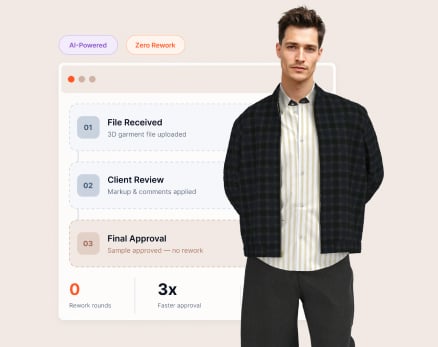
You reduce the number of approval rounds from three to five to one to two. Cycles operate on a daily basis rather than weekly.
Step 4: Revise Digitally, Validate Once if Needed
Small changes - seam shifts, construction details - do so digitally, re-simulate, resubmit. Brand reapproves digitally. No physical sample required. If significant fit changes are needed, cut one revision sample based on the digital file. Unless it is necessary to submit for approval, do not submit. Most changes do not.
No courier round-trip. No waiting. Cycle time drops from three to five weeks to five to seven days.
Step 5: Hand Off to Production with a Single Source of Truth
Once the brand approves the digital file, move to production. The technical pack includes the digital file, the material spec, and the validated physical sample. Production executes the approved file. FAI (First Article Inspection) confirms execution. Brand sign-off is confirmation, not rework.
Launch production, knowing the style is approved at spec, fit, and brand levels. No surprises. No rejection rounds.
Impact Summary
A style through traditional approval: 4-6 weeks, 3-5 physical iterations. The same style through digital approval: 2-3 weeks, 1-2 physical samples. For 100 styles per season at 3 revision rounds at USD 150 per revision: USD 45,000 shifts from rework to margin. Capacity equivalent to 20-30 additional styles without adding floor space or headcount.
Feature → Outcome Mapping
| Browzwear Capability |
What Changes in Your Workflow |
Business Outcome |
| Production-validated 3D simulation |
Validate specs against approved fits before cutting |
Eliminate 1-2 revision rounds per style; reduce cycle from 4-6 weeks to 2-3 weeks |
| Dimensional accuracy and measurement |
Verify seam placement and construction detail digitally |
Hand off files that match the spec exactly; remove interpretation from approval |
| Digital file-to-approval workflow |
Brand reviews and approves the 3D file digitally, no physical required |
Reduce approval rounds from 3-5 to 1-2; operate in days instead of weeks |
| Revision workflow and versioning |
Execute changes digitally, validate, and resubmit without rework samples |
Eliminate iterative material and labor cost; preserve margin per style |
| Tech pack generation from a 3D file |
Output a fully specified technical pack directly from a validated file |
Launch production with a single source of truth; eliminate FAI rework |
Comparison / Positioning Layer
Manufacturers that are still using traditional approval cycles have to work hard to get the job done: every change request requires physical rework, a courier round-trip, and waiting periods. Some try pre-sampling to compress cycles, but this leads to waste and inventory. Others push back on revisions - brands say no.
Digital approval does not ask brands to lower approval standards. It changes the medium. Instead of waiting for physical samples, they review digital files. Instead of waiting for the courier and re-cut, they see revised files in 24-48 hours. Approval pace is no longer constrained by physical logistics.
This is not speed-first. Production-validated digital samples are accurate by design. Brands get both accuracy and speed. But the manufacturers who master this workflow will win digital-first clients and retain clients who want faster cycles. Manufacturers who do not will find margins compressed as brands push cycles faster.
Objection Handling
"Will Brands Accept Digital Samples as Final Approval?"
This is the primary concern. The answer is: it depends on your production accuracy and the brand's digital maturity.
Brands in mature digital markets - UK, Germany, parts of Asia - have largely adopted digital approval workflows. North American brands are moving faster every quarter. But the critical variable is not brand willingness. It is your confidence in production accuracy.
If your digital files are not production-validated - if they show design intent but not manufacturing reality - brands will request a physical confirmation round, negating the efficiency gain. The solution is not to convince the brand to accept less accuracy. The solution is to produce digital files that are so accurate to spec and well-matched to your production capability that the brand sees no risk.
Start with one to three styles per season, committing to digital-only approval. Prove the workflow. Deliver on time with zero FAI issues. Brands will expand the program. Brands are not risk-averse - they are time-averse. Show them that digital approval saves time without adding risk, and adoption accelerates.
Structured Q&A
- Q: What is a production-validated digital sample?
- A: A 3D file built to exact technical specification, verified against approved fit avatars, and confirmed in a physical validation sample that your production floor can execute accurately. It is a manufacturing specification, not a design render, that both you and the brand use as a single source of truth.
- Q: How is this different from design-focused 3D files?
- A: Design files are creative ideas and have little dimensional precision and manufacturing detail. Production-validated files include all dimensions, seam specifications, material details, and hardware placement. Brands can even approve production files directly. Design files are about how intent is perceived and how a spec is created - where revision rounds come from in design files.
- Q: Can we submit digital files to brands without a PLM system?
- A: Yes, through shared portals or render images. Approval happens via email or signature. This works, but it is slower than brands with integrated digital approval. Make digital workflows the priority, as brands already take a digital-first approach to buying.
- Q: What happens if a brand requests a change?
- A: You revise digitally, re-simulate, and resubmit. If the change is minor - seam shift or hardware position - revision is purely digital. If it has a significant effect on fit, cut one revision sample to verify production accuracy, and submit both the revised file and the sample. Most brands confirm the revised file based on your feedback. Approval cycles are 3-5 days, not 3-5 weeks.
- Q: What is the cost of one validation sample?
- A: USD 120 to USD 300 depending on complexity. This is one sample per style, not iterative revision samples. Compared with traditional workflow: three to five iteration samples at USD 150 to USD 300 each (USD 450 to USD 1,500 per style). Digital workflow: one validation sample plus digital file creation (USD 120 to USD 300 per style).
Key Takeaways
- Eliminate physical sample revision rounds on a per style basis by moving approval to digital files that match the spec exactly and are production-validated.
- Reduce client approval cycles from 4-6 weeks to 2-3 weeks in days instead of waiting for a courier round-trip.
- Protect USD 80 to USD 300 per style in rework cost, multiplied across revision rounds - USD 45,000 per 100-style season shifts from waste to margin.
- Production-validated digital samples are built to the exact technical specification and verified in one physical validation sample to eliminate interpretation.
- Start with one to three digital-approval styles for the season with your most cooperative brands. Show the workflow - brands will grow adoption when they can see time saved without risk.
- Brands are sending a signal of readiness when they start with digital-first buying workflows and PLM systems. Integration with your ERP is done at the approved file stage.
- Capacity unlock equivalent to 20-30 additional styles per season, without adding floor space, equipment, or headcount.
Manufacturers who do their work quickly through approval cycles win clients who want it and retain them. See how digital samples from production can compress your client approval process from weeks to days and how that is reflected in your seasonal capacity.