Range Confirmation to Range Control
A range confirmed in the meeting room and reconfirmed three weeks later, once physical samples finally arrive, is not confirmed. It is provisional twice. For a Product Leader working against a fixed order date, that second confirmation is the one that actually decides whether the range ships on time, and it is also the one nobody put on the calendar. A digital range review earns vendor trust and replaces the physical check that used to follow it only when both sides confirm the same 3D file, in the same meeting, with a recorded sign-off. Anything short of that is a preview, not a decision.
Why vendors still expect a follow-up sample
The pattern of confirming twice did not occur by accident. Range confirmation was built around the physical sample: a garment only became real once a buyer could hold it, and every review step downstream assumed a physical object would eventually arrive to settle any doubt. When digital review entered the process, many retailers layered it on top of that assumption instead of replacing it. The meeting became a look at the range, not a decision about it, and the physical sample kept its old job as the actual point of confirmation.
This gap widens at scale. A Product Leader reviewing ranges across a dozen or more vendors, often on different systems and file standards, has no consistent way to prove that what was seen in the meeting is what gets produced. Without a shared file both parties can reference afterward, a vendor has little reason to treat the digital meeting as final. Sending a physical sample "just in case" costs the vendor little and protects them from a dispute later. The retailer absorbs the cost: a calendar slip of however many weeks that sample takes to travel.
Six steps to a digital review meeting vendors treat as final
Running a digital range review that vendors trust as the actual point of confirmation, not a step before it, depends on structure, not goodwill. Follow these six steps in sequence.
- Confirm the file before the meeting, not during it. Send the vendor the exact 3D file, fabric data, and colorway set that will be reviewed at least 24 hours ahead, and require written confirmation that it matches their production file. A review built on a file the vendor has not verified invites a later claim that the meeting reviewed the wrong version.
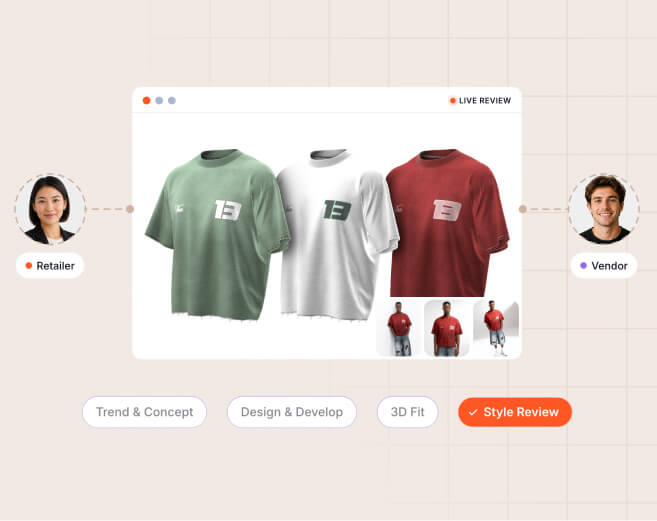
- Open the meeting on shared infrastructure, not a shared screen. Both sides need to see and manipulate the same live file inside one digital environment, such as Browzwear's StyleZone, rather than one party presenting a recording or a static render to the other. A shared environment means there is one file, one session, and one version of what was decided, not two separate views of a rendered image.
- State the meeting's purpose out loud: sign-off, not preview. Open every review by naming what the meeting will produce: a decision on fit, fabric, and colorway, recorded in that session. This single sentence resets vendor expectations that have been shaped by years of provisional reviews.
- Walk the garment, do not just look at it. Rotate the avatar, check fit at rest and in motion, and review fabric drape and colorway together, style by style, rather than scrolling through static views. Raise every question inside the session, while the file is open and both parties can inspect the same point at once.
- Record the decision inside the file. Log approvals, requested changes, and open items directly against the reviewed version, with a timestamp and both parties named. A decision that lives only in a meeting host's notes is a decision either side can later dispute.
- Close with a written sign-off distributed within the hour. Send a short confirmation summary, referencing the exact file version, to every attendee before the meeting has fully ended. Speed here matters: a same-day record leaves no window for a vendor to revert to "let us just send a sample to be safe."
What changes when the file is the record
| Browzwear capability |
Operational change |
Business outcome |
| Shared 3D review environment (StyleZone) |
Retailer and vendor view and manipulate one live file in the same session, instead of separate renders or PDFs |
Range confirmation happens once per style, cutting the review-and-reconfirm cycle out of the calendar |
| Photorealistic fit and fabric simulation |
Fit, drape, and colorway are assessed on a validated digital twin rather than a flat image or written description |
Fewer late-stage disputes over what was actually approved |
| Session-level annotation and revision history |
Every requested change and approval is attached to a specific file version and timestamp |
A defensible record either party can reference if a disagreement surfaces later in production |
| Centralized file versioning across vendors |
Every vendor's range sits in one system rather than in separate email threads and folders |
Faster range confirmation across a full vendor portfolio, with consistent review quality regardless of vendor size |
How the workflow runs end to end
Before Browzwear, a typical range review moves in one direction: a vendor sends renders or a physical sample, the retail team reviews it separately, feedback travels back by email, and a second or third round of physical samples follows before anyone signs off. Each round consumes shipping and rework time, and the record of what was approved lives across scattered messages rather than in one place.
With a shared digital environment in place, the sequence compresses. The vendor uploads the 3D file to the shared platform ahead of the meeting. Both sides open the same session, review fit, fabric, and colorway together, and close with a recorded decision. Where retailers run product lifecycle management or enterprise resource planning systems, the confirmed file and its sign-off record can flow directly into those systems, without a manual re-entry step. A physical sample, when one is still produced, becomes a final production check, not the point of confirmation.
Digital review versus a preview that still needs proof
Some review processes prioritize speed of assembly over the durability of the decision made in the room. A meeting that moves quickly through many styles but produces no recorded, file-level sign-off has not confirmed anything; it has scheduled a future confirmation and called it done. That looks efficient on the calendar until physical samples arrive and reopen decisions the team believed were closed.
A digital range review built on a shared file and a recorded sign-off makes the decision durable at the moment it is made. The trade-off retailers should weigh is not speed against accuracy. It is one confirmed decision against two provisional ones, only one of which is on the calendar.
Addressing the vendor trust objection
The most common reason a Product Leader hesitates to run digital review as the final word is a fair one: vendors, used to years of physical sign-off, may nod through the digital meeting and still ship a sample "to be sure," which adds a step instead of removing one. The fix is structural, not persuasive. When the reviewed file, the fit and fabric assessment, and the recorded approval all live in one session both parties can reference, the vendor has a defensible record if a dispute arises later, the same protection physical samples used to provide. Once vendors see that the digital record protects them as well as the retailer, the follow-up sample stops being a hedge and becomes an optional final check, not a second confirmation. A second concern: will smaller vendors with less 3D experience accept this workflow? Most already produce 3D files for other retail clients, and a shared review environment does not require new internal tools, only bringing the file to one common session. This guide, file sent in advance, decision recorded in the meeting, gives newer vendors a clear, low-effort way to participate with confidence.
Common questions about digital range review meetings
What is a digital range review meeting?
A structured session in which the retailer's Product Leader and a vendor review the same 3D garment file in real time and record fit, fabric, and colorway decisions against that file.
How is this different from a digital sample preview?
A preview shows the range without a binding decision. A digital range review ends with a recorded sign-off to a specific file version, making it the point of confirmation rather than a step before one.
Does a digital review meeting replace the physical sample entirely?
Not always. It replaces the physical sample as the point of confirmation. A physical sample can still serve as a final production check, but the range is already confirmed before it ships.
What is the reason vendors still expect a physical follow-up check?
There is no shared, recorded file that both parties can reference after the meeting. Without that record, a vendor has little assurance the digital decision will hold, so a physical sample becomes their protection.
How long does it take to run a review this way?
The steps add minimal time to an existing meeting. The main change is in format and sequencing, sending the file in advance and closing with a written record, rather than adding meeting length.
What should a Product Leader ask of vendors before the first digital review?
A verified 3D file that matches production specifications, delivered before the meeting, and agreement to treat the recorded sign-off as final.
Key takeaways
A digital range review only replaces the physical check when both sides verify the same 3D file, in the same meeting, with a recorded sign-off. Reviews that end without a file-level record are previews, not decisions, regardless of how many styles they cover. Vendor trust in digital sign-off increases when the recorded file protects the vendor as much as the retailer. A shared digital environment, rather than separate renders or screen shares, is what makes a single confirmation possible. Structure, not persuasion, is what stops a vendor from defaulting to a follow-up physical sample. Confirming a range once, on the record, removes weeks of shipping and rework time from the buying calendar.
Retailers who are running range review through Browzwear confirm ranges faster, with fewer physical review rounds and clearer vendor alignment at every step. Check if it works for your buying calendar.