Eliminating Costly Late-Stage Design Changes with 3D Development
Late-stage design changes cost up to 10x more to fix. See how 3D development with production-validated digital twins eliminates them before they...
Your capacity problem is not a floor space problem. It is a sampling round problem. Every additional physical iteration a brand client requires - proto, sealing sample, production sample - consumes time, material, and technical attention that could be allocated to the next style in the queue. At three to five sampling rounds per style across a full seasonal book, the ceiling on what your facility can process is set before a single cut is made.
Manufacturers that adopt production-ready 3D digital files reduce physical sampling rounds per style by up to 80%, unlocking seasonal capacity without adding floor space or headcount.
A factory's throughput per season is constrained by the number of active sampling cycles the technical team can manage in parallel. Each style in development holds a lane - materials allocated, pattern makers engaged, quality review committed - until the client signs off. When that cycle runs three or more rounds, the lane stays occupied far longer than the production time that follows.
At $200 to $500 per physical sample and four to six rounds per style, the sampling budget for a client sending 200 new styles per season approaches seven figures before a single production unit ships. More critically, the time sampling consumed is irreversible. Capacity lost to revision rounds cannot be recovered within the same seasonal window.
Brand clients increasingly arrive with digital files. The distinction that determines your facility's exposure is whether those files are design renders or production-ready digital twins. One requires you to interpret intent and absorb the risk of misalignment. The other arrives with fit validated, fabric behavior confirmed, and construction logic embedded. The first path sustains the bottleneck. The second breaks it.
The following stages describe how the development cycle runs when a manufacturer receives production-ready digital files from brand clients working in Browzwear. Each stage replaces or compresses a step that traditionally required physical sample exchange.
When a client submits a Browzwear digital file, the production team receives a complete technical package: fabric properties from certified mill data, pattern pieces with seam allowances in DXF format, construction annotations embedded in the 3D model, and a bill of materials consolidating all trims, colorways, and material callouts. Technical designers review the file before any physical material is committed. Construction inconsistencies and material substitution needs are identified at the file stage - not after the first sample returns from the sewing floor.
Most first samples fail not because of execution, but because of specification. When a factory builds a manually constructed tech pack - assembled after design is complete, with measurements pulled from a 2D sketch - interpretation errors enter at the starting point. The physical sample becomes a discovery exercise.
A Browzwear-generated file eliminates that gap. Measurements are structural data, not manual entries. Fabric behavior is defined by actual physical properties. Construction logic is embedded in the pattern. When the factory builds to that file, the first physical sample confirms fit rather than correcting construction. Each improvement in first-sample accuracy directly translates into fewer sampling rounds per style.
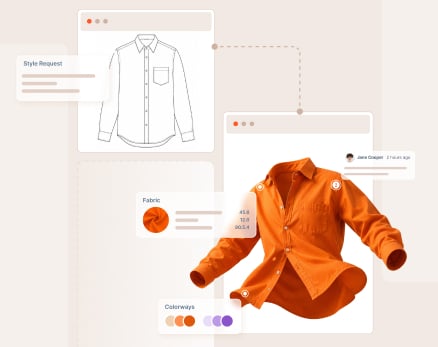
Browzwear's Stylezone platform allows brand and production teams to review digital assets, annotate fit and construction details, and approve colorway changes without a physical garment in transit. Decisions that previously required two to three weeks of shipping and review are resolved in a single digital session - a direct capacity multiplier across a full client portfolio.
With a production-validated digital file as the baseline, the sealing sample becomes the primary physical event in the development cycle - a quality confirmation, not the endpoint of a correction sequence. The handoff to the production floor carries the same file integrity: pattern pieces, grading instructions, and material specifications drawn from the validated model. Production errors originating in the handoff between development and manufacturing are reduced.
| Browzwear Capability | Operational Change | Business Outcome |
|---|---|---|
| Production-ready digital file with embedded construction logic | Technical review replaces first-round interpretation; errors caught before physical sampling begins | One to two physical rounds are eliminated per style; first-sample accuracy improves |
| Physics-based fabric simulation from certified mill data | Fabric behavior confirmed in the file, not discovered in the first proto | Material-related revision rounds reduced; cost per sample iteration decreases |
| DXF pattern export with seam allowances and grading | Pattern files accompany the spec, ready for the factory floor without re-drafting | Pattern interpretation errors eliminated; production handoff accelerated |
| Stylezone digital review and annotation | Client feedback and approval occur on the digital asset, not the physical sample in transit | Feedback cycle compressed from weeks to days; more styles active per season |
| Open Platform with PLM and ERP integration | Digital file data flows into existing production management systems without manual re-entry | Data integrity maintained across development and production; no replacement of incumbent systems required |
Browzwear is built on an open platform architecture. Structured data exports - BOM in Excel, measurements in CSV, pattern files in DXF - import directly into major ERP and PLM environments without custom connectors. For facilities whose clients operate in SAP or PTC Windchill, Browzwear has established integration paths. The scope is bounded. It is not a replacement project.
Technical Designers and Pattern Makers operate in Browzwear's environment with a learning curve supported through Browzwear University's on-demand training. Facilities running pilot programs with a single client account typically achieve operational fluency within one to two seasonal cycles, scaling as digital file volume increases.
Not all digital files from brand clients carry the same production value. Design renders show color, surface, and proportion accurately - effective for commercial photography, insufficient for manufacturing.
A design render contains no construction logic. Pattern data, seam allowances, grading instructions, and fabric properties are absent. The factory still handles all technical interpretation on the production side, and the sampling cycle remains unchanged.
Production-ready files generated through Browzwear's physics-based simulation carry a fundamentally different technical payload: fit validated against avatar bodies, fabric behavior confirmed from certified physical measurements, and pattern data identical to the validated digital twin. There is no translation layer. There is no interpretation gap. For manufacturers operating at scale, this distinction determines whether digital inputs reduce the number of sampling rounds in practice or simply add a review step before the same physical cycle begins.
A facility running SAP, Oracle, or a legacy MES cannot absorb an integration project requiring custom development or parallel data maintenance. Browzwear's structured exports - CSV, DXF, Excel - import directly into the most common ERP and PLM environments. The integration conversation is a scoping exercise, not an open-ended development commitment. The practical starting point is a single client account over one seasonal cycle. The integration scope for a single account is actually contained; expansion follows the demonstrated return.
The brands requiring digital-first workflows from production partners are increasingly the same brands that represent the largest and most commercially stable accounts. Digital file capability is becoming a qualification criterion. Manufacturers that build 3D intake capability now are positioned to retain those accounts and qualify for new ones that competitors without digital workflows cannot serve. For clients not yet sending Browzwear files, Browzwear's commercial model supports brand client onboarding as part of manufacturer partnerships. The capability builds in both directions.
Manufacturers using Browzwear are processing more styles per season with fewer sampling rounds - and winning clients who require digital-first workflows. See what that looks like in practice with a live walkthrough built around your facility's volume and client mix.
