But brand clients are not waiting. The buyers, product teams, and technical directors at apparel brands are already asking their vendor shortlist one question before they get to price, lead time, or capacity: Can you work in 3D? Manufacturers that cannot answer clearly are losing ground - not because they lack the capability, but because they do not know how to present it.
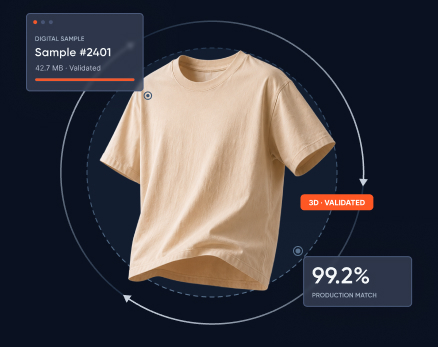
Manufacturers who provide production-validated digital samples to brand clients make their facility the lowest-risk, fastest-to-first-sample option on any vendor shortlist. The pitch is not about selling a technology investment. It is about proving, in the language brand clients already know, that working with your facility means fewer surprises, fewer sampling rounds, and a faster path from brief to approved product.
This guide also explains to Production leaders how to structure that pitch: what to show, what to say, and how to structure the conversation so it aligns with the brand stakeholders who make the decision.
Why Brand Clients Are Asking the Question Now
The change is structural, not cyclical. Apparel brands are under pressure to speed up development timelines, reduce sampling waste, and connect cross-functional teams, rather than waiting for physical products to move from the office to the factory. Digital-first workflows are the operational response to all three pressures at once.
As a result, the brand product and technical teams have changed what they look for in a production partner. A facility that can receive and work from a digital file - and return a production-validated digital sample instead of a physical one - shortens the client's development calendar by weeks. Manufacturers who can demonstrate this capability are not simply filling out a box on a vendor form. They are taking away the biggest scheduling risk for the client.
Step 1: Separate Capability from Readiness
The most common mistake in a 3D capability pitch is to conflate what your facility can do with what it is fully ready to do at scale. Brand clients can spot overstatement quickly, and a pitch that outsprints your actual deployment creates risk that takes months to recover from.
The right framing is honest and progressive. Distinguish between three capability tiers:
- Active 3D production - styles already developed and sampled digitally end-to-end with physical output matching the digital file.
- Piloted capability - a set of styles run through the full 3D workflow in a controlled environment, results verified.
- Onboarding capability - platform deployed, team trained, first live project in progress.
Each tier has a credible pitch. To present the current tier accurately, then describe the trajectory: how and when you move from piloted to active, and what a brand client who engages now can expect over the next 12 months.
Step 2: Build the Evidence Package
Brand customers evaluate digital capability claims the same way they evaluate any production claim - they want to see it. A verbal pitch without supporting material lands as aspiration. A pitch anchored in evidence lands as capability.
Build a concise evidence package for client-facing communications before any client-facing conversation. Four components:
Digital sample archive. Completed digital garments developed in Browzwear across product categories relevant to the brand's portfolio. Export renders and turntable views that the client can evaluate without specialist software.
Before-and-after development summary. For at least one of them, show the conventional sampling path followed by the digital path - rounds are cut, timeline compressed, and cost per iteration lowered. Specific numbers from a single pilot are more persuasive than general ones.
Technical pack compatibility proof. Show that your facility can receive a brand's digital file format, interpret it accurately, and return a production-ready output. If Browzwear is connected to your PLM or order management workflow, document that integration. Brand technical directors will ask.
Team credential summary. One page. Who is trained, at what level, and on which Browzwear modules? This demonstrates that the capability is embedded in your operation, not dependent on a single operator.
Step 3: Frame the Pitch Around the Brand's Risk
Production leaders who have invested in 3D capability often frame the pitch around the investment: platform cost, training hours, and operational change. Brand clients do not buy that framing. They are taking development risk themselves at the core of their decision, and what they are really asking is: what happens to my calendar and my sample budget if I work with this facility?
Reframe every capability statement in terms of the client's outcome.
| Browzwear Capability |
Operational Change for the Brand |
Business Outcome |
| Production-validated digital samples |
Brand gets a digital file that will look like real construction, not a prototype design |
Approval decisions made earlier, fewer physical review rounds needed |
| Fabric simulation accuracy |
The pack interpretation process is done on the digital side rather than any physical cut |
The first physical sample looks closer to the approved specification |
| Digital colorway and trim switching |
Brand takes multiple options into account in one review cycle without additional samples |
Range selection is verified, and a lower per-style development cost is achieved faster |
| File format compatibility with the brand PLM |
No translation layer needed between brand brief and factory floor |
Brief-to-sample lead time shortens; new style onboarding compresses |
| Digital fit validation before physical sampling |
Fit issues flagged and resolved at the digital stage |
Physical sample rounds reduced per style; production calendar tightens |
Anchor your pitch in two or three of these outcomes - the ones that are most relevant to how the specific brand you are pitching works today.
Step 4: Handle the Readiness Question Directly
Every brand client will ask some version of the same question: how do we know this will hold at scale? Avoiding it or deflecting it damages credibility faster than any honest answer would.
Address it in three moves.
First, clearly define the scope of your current capabilities. A scoped capability that is reliably delivered is more valuable than an unlimited claim that cannot be substantiated.
Second, offer a structured pilot. Propose one product category, one season, tracked against conventional development metrics. A pilot frames the first engagement as shared learning rather than a production risk and provides your team with a controlled environment to demonstrate performance before the relationship scales.
Third, commit to a clear escalation path. If a digital file raises a technical question that requires physical resolution, what is your process? Brand clients need to know the digital workflow has a fallback - not because they expect failure, but because they are accountable for their own calendar.
Step 5: Pitch at the Right Level
A 3D capability pitch is not a single conversation. The stakeholders who evaluate it sit at different levels of the brand organization, and each one needs a different version of the argument.
Brand technical directors and product development leads evaluate at the file and workflow level. They want to see format compatibility, construction accuracy, and how your facility handles revision cycles. Lead with the evidence package and the digital sample quality.
Brand production and sourcing leaders evaluate capacity and calendars at the capacity and calendar levels. They want to know how many styles per season your facility can run through a digital workflow and what the timeline looks like from brief to digital sample. Lead with the before-and-after development summary.
Brand commercial or buying leadership is evaluated at the risk level. They want to know that choosing your facility does not present calendar or quality uncertainty. The pilot proposal and the escalation path should be the start.
Run the pitch through all three levels in sequence. Technical buy-in without commercial buy-in does not close business. Commercial buy-in without technical credibility does not hold.
Common Questions from Brand Clients
- Q: What does it mean for a manufacturer to have "production-validated" digital samples?
- A: A production-validated digital sample is made from the same technical data used to cut and construct the physical garment. It reflects true fabric behavior, construction detail, and fit, not a stylized render. When a brand approves one, that decision stands on the factory floor.
- Q: How does a manufacturer's 3D capability affect the brand's development timeline?
- A: If a manufacturer returns a digital sample instead of a physical one, the brand's first review round happens weeks earlier. The fit and colorway decisions are made before physical sampling begins, so the rounds needed to secure production approval are reduced.
- Q: What is the difference between a design render and a production-ready digital sample?
- A: A design render is produced for visual presentation. A production-ready digital sample is constructed from a technical pattern, simulated with accurate fabric data, and tested for fit and construction. Only the latter can substitute for a physical sampling round.
- Q: How should a manufacturer respond to the first client conversation about 3D capability?
- A: Begin with evidence, not claims. Show finished digital samples, a before-and-after development summary, and technical pack compatibility. Then develop a pilot on a specific product category.
- Q: What if a manufacturer's 3D capability is still in early deployment?
- A: Present it accurately as a piloted capability with a defined trajectory. Brand clients appreciate honesty about the deployment stage. Provide an overview of the current capability, name the investment in progress, and suggest a pilot that matches your actual readiness.
- Q: How long does it take a manufacturer to go from 3D onboarding to active production capability?
- A: Manufacturers running a focused pilot on a specific category can show active capability within a single development season. Full deployment across a wider product range typically takes two to four seasons.
Key Takeaways
- Manufacturers who produce production-validated digital samples to brand clients will be viewed as the lowest-risk and fastest-to-first-sample candidate on any vendor shortlist.
- A good pitch is only as good as the evidence behind it - create a digital sample archive, a before-and-after development summary, and a technical pack compatibility proof before any client interaction.
- Frame every capability statement around the brand's outcome: fewer sampling rounds, shorter development timelines, and earlier approval decisions.
- Decide on your current capability tier and outline your current trajectory with a clear trajectory - overpromising creates client-facing risk that takes seasons to recover from.
- A well-structured pilot proposal is more persuasive than a full-scale commitment request, and lower risk for both parties.
- The pitch passes through three levels of stakeholder levels: technical, production, and commercial. Each needs a different version of the argument.
Manufacturers working with Browzwear are demonstrating production-validated digital capability to brand clients today - and winning business from vendors who cannot. See what the pitch looks like when it is built on real platform capability.