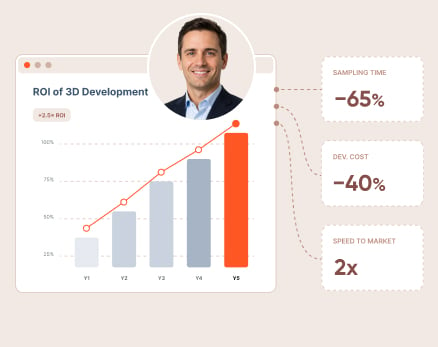
Constructing a strong internal business case for 3D apparel development is one of the highest-leverage actions a CPO can take on a digital transformation journey - and one of the worst mismanaged. The technology is sound with the switchover from physical to digital prototyping. It fails on alignment. Different 3D development approaches are pursued through design, production, and finance, and if these lenses don't align, the initiative stagnates before it begins. This guide provides CPOs with a structured approach to organizing the case, clarifying each stakeholder's key concerns, and transitioning the design to approval.
Why Internal Consensus Is the True Barrier
Those CPOs leading successful 3D rollouts have consistently found that the technology was never the challenging part. The difficult part was walking into a room and talking to the CFO, the Head of Production, and the VP of Design - all in their own languages at once.
Finance desires to see the cost decreased, sample spend, freight, and cycle time. Production seeks guarantees that digital files will be production-validated, not decorative. Design should feel that, because of process efficiency, there will be no trade-off between creative quality and efficiency. But every issue is valid. A business case that is written to talk about but one of them - or worse, to all three in the same generic way - leaves the room.
Instead, the CPO's role is to convert a single initiative into three separate value stories, then unify them around a shared vision of what digital product development at scale looks like.
Before You Put Forward the Solution, Frame the Problem
Internal proposals fail when they start with the tool rather than the problem. Even before naming any 3D software, the Business Case must clearly state that the current process is costing the organization in tangible, growing ways.
Begin with a diagnostic snapshot over three broad axes:
- Sample cost and cycle time. How many physical samples does the organization produce per season, per style? What is the average cost per sample, including materials, labor, and freight? How many rounds of revision does a typical style require before range confirmation?
- Speed to market. How many weeks are consumed between design intent and buying calendar lock? Where are the handoff delays - between design and technical design, between technical design and vendors?
- First-sample accuracy. What percentage of first samples are approved without revision? Brands with 40-60% first-sample accuracy on complex styles pay a quantifiable cost for the missed opportunity to approve.
Once those numbers are on the table, the reasons for change begin to write themselves. The answer is no longer "Why should we invest in 3D?" - it turns into "How much longer can we afford not to?"
Construct the Case for Three Stakeholder Focus
Good business cases communicate directly to their internal audiences. Here's how to package the value for the three most likely stakeholders to wield veto power.
For Finance: Cost Reduction Argument
Finance reacts quickly to hard numbers. The financial case for 3D development is best made through reduced sample sizes. Brands that transition to digital-first prototyping reduce physical sample rounds by about 50% or more per style. At scale - across hundreds of styles in a single season - it adds up to overall material savings in costs of production, freight, and storage.
More than sampling, the financial case should involve:
- Less risk of markdown - fewer unvalidated styles in a brand that is going to be produced
- Accelerating development cycles, giving way to later buying calendar lock and a more responsive range
- Lower revision cost in the digital environment vs physical samples, as changes are made in that environment instead of going through the physical format
To be persuasive, the ROI model doesn't need to be perfect. It must be credible and based on the organizational cost baseline itself. If you don't already have a sampling cost audit, it is the first deliverable before talking to Finance.
For Production: The Accuracy and Integration Argument
Not all production leaders are opposed to digital tools, but all are skeptical of those that create more work downstream. The concern is valid. Early-generation 3D visualization yielded gorgeous renders that had little to do with how a garment behaved during manufacturing. That time has gone by, but the memory remains.
There are two points underlying the production case. First and more importantly, production-validated digital twins - constructed with precise fabric physics, construction logic, and grading - decrease, instead of increase, the technical risk during development. Second, by plugging into the current PLM and tech pack workflows, digital assets do not exist in isolation. They migrate with the product throughout development.
Concrete proof points count, therefore. Specific outcomes include: design scenarios in which digital prototypes avoided rounds of revision, tech packs produced from digital 3D files, and supplier onboarding timeframes shortened by digital hand-offs.
For Design: The Creative Quality Argument
Design leaders must realize that digital development enhances (rather than constrains) the creative ambition inherent in creative endeavors. The best case for design teams is iteration speed - the potential for more colorways, more construction variations, and more styling options within the same time frame without waiting for physical samples to confirm direction.
Digital twins also provide design teams with something in contrast with physical samples - the ability to examine a garment across all colors at once, on different body types and lighting conditions. Decision-making needs that previously required a sample room can now be handled in a shared digital environment, with buyers or merchandising teams working remotely.
The design case is also a talent case. Studios that run with sophisticated 3D workflows would bring a different caliber of technical designer to a studio - one who could fluidly switch between creative and technical duties, and thus would shorten the handoff that has been a bottleneck to development for a while.
Avoid the Risk Objections Directly
The approval process for any platform of this scope faces the same internal objections: "What if this doesn't work?" This is seldom stated explicitly, but it underpins all the questions you ask about implementation dates, change management, vendor stability, and so on.
Present an alternative approach that enables the implementation of a model and makes all parties have some level of buy-in to the solution, and thus neutralizes the risk objection effectively, such as showing a phased as opposed to binary path to adoption. No full-fledged organizational roll-out is required - and at best is not recommended - as an initial step. Trying out 3D development in one category or style helps the organization keep it small and focused, validating success, building internal capability, and producing proof points faster for wider adoption.
Collaboration with a trusted partner whose technology and products the fashion world knows across more than 1,000 companies also shifts the risk calculus. Enterprise adoption at this scale means the implementation playbook is set up, integration pathways are documented, and the onboarding support structure is in place. The CPO is not asking the organization to bet on technology they can't trust - he or she is asking them to join an industry function that is already benchmarked and functioning.
Develop the Approval Roadmap
A business case is a document. An authorized initiative takes conversations. The majority of CPOs who gained internal approval for 3D investment in their organizations followed the same path:
- Pre-sell with data. Share the diagnostic snapshot with each stakeholder before the formal proposal, with a special mention for each individual stakeholder. Let them react to the problem before having them evaluate a solution.
- Present a gradual plan, not a one-off platform bid. The first ask should be for a pilot: a defined scope, a defined timeline, and a defined series of success metrics. But it is simpler to approve than a multi-year transformation program.
- Create an internal champion in every function. All need a named owner, accountable for documenting results at their jurisdiction - finance, production, and design. This takes the project out of the CPO's office and creates cross-functional investment in success.
- Set a 90-day review. Insert a formal checkpoint into the approval. Nervous stakeholders are willing to commit to a 90-day pilot rather than an indefinite rollout. The review serves as the occasion to showcase early wins and scale the case for larger investment.
Key Takeaways
Building a persuasive internal business case for 3D apparel development involves translating one initiative into three value stories - Finance, Production, and Design - and pulling them back together into one common vision.
- Present a diagnostic snapshot of current sample costs, cycle time, and first-sample accuracy before naming the solution. Let the problem make the case.
- Sample reduction ROI receives a response from finance. Production must prove accuracy and PLM integration. Design needs testament that creative quality grows, not shrinks.
- Defend a staged pilot approach that neutralizes the risk objection. So, a contained first step is easier to approve and produces proof points for wider adoption.
- Partnering with an enterprise partner trusted by upwards of 1,000 fashion and apparel companies alters the risk calculus. You have the implementation playbook. We already have onboarding support set up.
- Sequence the internal dialogues: pre-sell with data, present a plan in stages, and assign cross-functional champions, while making a 90-day review an embedded checkpoint.
Ready to Take the Next Step?
If you're ready to establish the internal case for 3D development at your organization, Browzwear collaborates with product leaders across the industry, working with their team size, category mix, and level of maturity to shape their approach. Use it by booking a demo to check out how the platform stacks up against your workflow issues and what a phased rollout might look like for your brand.