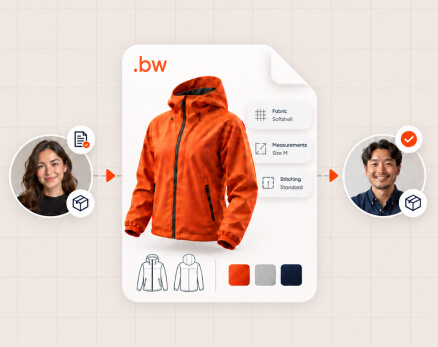
Switching Suppliers Mid-Season with One 3D File
A tariff notice or a cost spike hits during week six of the season and a style that was on track now requires a different supplier. The approved sample, fit comments and fabric decisions remain with the old vendor. The new one starts from a sketch and a request for a first sample. A switch that should cost days costs the calendar.
A shared 3D garment file changes that handover. It allows a Product Leader to move a style to a new supplier mid-season by passing the approved build, the fit block, and the fabric data to the new supplier. So the new supplier starts from a validated digital twin instead of a sketch and a physical sample.
What actually moves when sourcing changes
Most retailers treat a supplier switch as a purchasing event. Product Leaders know it is a product development event. The order moves in a day. The style knowledge takes weeks to rebuild.
That knowledge lives in all three places: the construction details, the fit decisions and the fabric behavior. In a physical workflow, all three reside inside a sample, a tech pack, and the memory of a fit session. None of them transfer cleanly. The new supplier interprets the tech pack, builds a first sample and the fit conversation begins again from round one.
Trade and cost volatility makes this a recurring pressure, not a one-time event. Now to get flexibility you will need to know how quickly a style can move on without losing what the team has previously approved.
The thesis: a style should travel as a build, not as a brief
A sketch and a tech pack describe a garment. A production-validated digital twin is the garment, built, fitted, and simulated in a state the team already signed off on.
When a style moves as a build, the new supplier opens the file and sees the pattern pieces, the seam construction, the fabric assignments, and the colorways. The supplier does not interpret intent. The supplier inspects an approved result.
This is the POV: apparel sourcing change should be a handover of an approved build, not a restart of development.
Evidence: the cost of restarting
There are four losses when a switch restarts development.
- Sample rounds repeat. The new supplier needs a first physical sample to confirm what the old one already confirmed.
- Fit decisions are lost. Comments from the original fit sessions are left in emails and sample photos and not in the garment.
- Fabric behavior changes. A new mill or a new interpretation changes drape and stretch and nobody sees it until the sample arrives.
- The calendar absorbs all of it. Every round brings the style closer to a missed window.
None of these losses comes from the new supplier doing poor work. They arise from a handover that carries a description instead of the garment.
What the shared file carries
A Browzwear digital twin keeps construction, fit, and fabric data in one file. The file format contains the full 3D garment, including pattern pieces, seam data, fabric assignments, colorways, and simulation parameters.
Three components make the handover work:
- The approved build. Pattern, construction and simulation, exactly as the retailer signed off.
- The trusted fit block. A validated block the style was built on so fit does not start from zero. A trusted fit block library gives every future switch a proven starting point.
- The measured fabric. Fabric properties captured from the physical material, so the twin drapes and stretches like the real cloth.
| What moves | In a physical handover | In a shared 3D file handover |
|---|---|---|
| Construction | Interpreted from a tech pack | Inspected in the approved build |
| Fit | Rebuilt through new fit rounds | Carried by the trusted fit block |
| Fabric | Described by name and weight | Applied from measured properties |
| Approval record | Scattered across emails and samples | Held in one file |
From switch notice to first review: the handover sequence
A Product Leader can conduct a mid-season switch in five stages.
- Freeze the approved twin. Lock the version the team signed off on, with fit block and fabric data in the file.
- Share the file, not a brief. Take the twin through a shared review space so the new supplier opens the same asset the retailer approved.
- Run a joint walkthrough. Review construction and fit with the supplier on screen. Ensure that they can open, read and question the file.
- Focus only on the differences. List only what changes at the new supplier: machinery, fabric source, trims.
- Decide what needs a physical sample. The file needs only a physical sample for the gaps the file cannot answer.
The sequence puts the supplier's first contact with the style on an approved result. The physical sample becomes a confirmation, not a starting point.
Where this fits in the retail workflow
The shared file lies between product development and sourcing. Before a switch, the file is in the review workflow as the approved asset. During a switch, it is the handover package. After a switch, it remains the reference for every later change order.
Each part of that flow stands alone. The twin is the system of record for the style. The fit block is the reference for the body. The measured fabric is the reference for the material. A supplier doesn’t need the history to begin with. The supplier needs the file.
Positioning: speed alone does not make a switch safe
Some approaches move at a high speed, generating images or quick renders of a style. These assets help in a conversation, but they do not carry pattern accuracy or fabric behavior to a factory. A supplier cannot build from a picture.
Other approaches are accurate but never leave the studio, so the supplier still works from a flat document. Enterprise-grade handover requires both: production-validated accuracy and a format a supplier can open. That combination is what enables a retailer to change sourcing without changing the product.
Objection: the new supplier will not use or trust the file
This is the barrier that matters most. If a supplier without 3D skills ignores the file and asks for a physical sample, the sample cycle restarts anyway, and the switch gains nothing.
Three moves reduce the risk.
First, start the conversation with a review, not a file transfer. A supplier who watches the twin move on screen sees a garment, not a technical object. Trust builds when the supplier checks the file against what they know about construction.
Second, define a narrow role for the file. The supplier does not need to author in 3D. The supplier needs to open the file, read the construction and flag gaps. That is a lower bar than full adoption.
Third, keep the physical sample available only as a fallback for flagged gaps. This tells the supplier that the file is the primary reference and the sample is the exception.
Retailers who set this expectation in the first review find the file becomes the working reference, not a courtesy attachment.
Second objection: is a digital twin accurate enough to switch on?
Accuracy depends on the inputs. A twin built on measured fabric data and a validated fit block holds up at handover. A twin built on assumed fabric and an untested block does not. The file helps a switch only when the team treats validation as part of the build, not as an extra step.
Q&A
What does switching suppliers mid-season mean for apparel product development?
It means moving an in-development or confirmed style to another manufacturer during the same season, usually for tariffs, cost changes, capacity limitations, or quality problems. The product remains the same. The production partner changes.
What is a shared 3D garment file?
A shared 3D garment file is a digital twin of a style where construction, fit, and fabric data are stored in one asset. Retailers and suppliers open the same file, so they work from one approved build.
How does a shared 3D file help with a supplier handover?
It replaces a sketch and tech pack with an approved build. The new supplier oversees construction, fit, and fabric directly, minimizing interpretation and removing the need to rebuild the style from a first sample.
What is a trusted fit block library?
A trusted fit block library is a set of validated blocks a retailer reuses across styles and suppliers. Each block has proven fit - a new style or a new supplier starts from an approved base.
Does a new supplier need 3D skills?
A supplier needs to open the file, read the construction and flag gaps. Full 3D authoring is not required to start. A joint walkthrough in the first review builds the confidence to work from the file.
Does a shared 3D file remove physical samples?
No. It moves the physical sample from the starting point to a targeted confirmation for gaps the file cannot answer, such as a new fabric source or a new machine capability.
Key takeaways
- A shared 3D file allows Product Leaders to move a style mid-season by passing the approved build, the fit block, and the fabric data together.
- A supplier switch is not just a purchasing event but a product development event.
- A style that travels as a build starts the new supplier from an approved result, not a sketch.
- A trusted fit block library gives every future switch a proven starting point.
- The conversion risk is supplier adoption, so run a joint review before sending the file.
- And that physical sample is just a check mark for flagged gaps rather than a restart of development.
- When the approved style resides in a file that the team controls and not in a single vendor’s sample room, the flexibility of sourcing grows.
Ready to see a handover in practice?
Retailers working with Browzwear shift styles from suppliers to an approved digital twin with fewer physical review rounds and cleaner alignment at all stages. See how a mid-season switch works for your buying calendar.
