News
How to Scan and Digitize Fabric
With Browzwear Fabric Analyzer, it’s faster and easier than ever before to see your fabrics in true-to-life 3D.
September 24, 2026
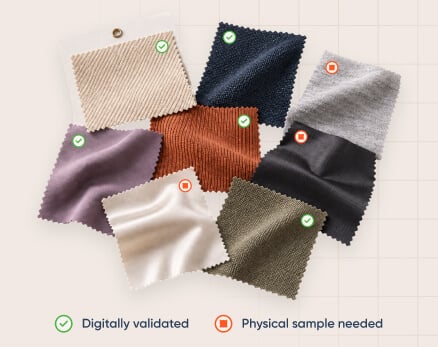
Digital sampling delivers production-validated accuracy for structured wovens and stable knits today, but high-stretch, bonded, and technical performance fabrics still require at least one physical checkpoint to confirm fit, recovery, and hand before final sign-off. That is not a gap in the technology. It is the boundary of what any simulation engine can responsibly claim, and Production Leaders who plan around it protect margin instead of losing it to rework.
Every 3D sampling platform simulates physics: weight, bend, stretch, and drape, applied to a digital pattern. The accuracy of that simulation depends on how completely a fabric's mechanical properties can be measured and modeled, not on how advanced the rendering looks on screen. Structured wovens and stable knits behave predictably under load, so their measured properties map cleanly onto a digital twin. High-stretch performance knits, bonded and laminated multi-layer constructions, and fabrics that shift hand and recovery after washing or heat-setting introduce variables that are harder to capture in a single property set. Fabric physics researchers and independent testing bodies have documented this gap for years: anisotropic stretch, multi-layer bonding, and finish-driven behavior change remain the hardest categories for any cloth simulation engine to model without a physical check. Production Leaders who plan sampling calendars without accounting for this split end up discovering the limitation mid-season, at the worst possible time to add a sampling round.
Browzwear validates simulation accuracy fabric by fabric using Fabric Analyzer, which measures physical fabric properties and applies them to a digital twin. That measurement process sorts fabrics into three readiness tiers rather than treating every material as equally simulation-ready.
Structured wovens such as twills, poplins, canvas, and standard denim, along with stable and compact knits including interlock, ponte, and low-elastane jersey. These fabrics carry predictable, well-measured mechanical properties. Styles built in these fabrics can move through the full development and approval cycle without a physical sample.
Midweight fleece, moderate-elastane knits, and select bonded fabrics with a single dominant layer. Digital sampling carries the majority of the development cycle: pattern iteration, fit review, and stakeholder approval. One targeted physical check confirms specific properties, typically at a grading extreme or a critical fit point, before final production release.
High-stretch and compression performance knits with heavy elastane content, multi-layer bonded and laminated technical outerwear, and fabrics with mechanical finishes that alter drape and hand after washing. These categories require a physical sample to confirm fit and recovery before manufacturing sign-off, even within an otherwise digital-first workflow.
This is the "when not to use this approach" moment, and it belongs in the framework, not hidden from it. A defined tier three protects tier one and tier two from doubt. Naming the fabrics that still need a physical check is what makes every other digital sign-off credible.
| Browzwear capability | Operational change | Business outcome |
|---|---|---|
| Fabric Analyzer property mapping | Every fabric entering development is measured and classified into a readiness tier before pattern work starts | Production teams stop guessing which styles can skip a physical round, cutting wasted sampling on fabrics that were never going to hold digitally |
| Tiered sign-off protocol | Full digital approval applies only to fabrics Browzwear has validated as tier one, not to every file uniformly | Higher first-time-right rate on eligible styles and fewer late-stage rejections from brand clients |
| Documented checkpoint for tier two and tier three fabrics | One targeted physical check replaces a full multi-round sampling cycle on higher-risk fabrics | Sampling rounds per style drop even on fabrics that are not fully digital, protecting capacity gains across the whole book of business |
| Simulation transparency reporting | Technical teams can show clients exactly which properties were measured against physical fabric versus modeled | Stronger client retention and fewer disputes over fit accuracy at delivery |
Fabric readiness classification happens at intake, before a style enters development. When a brand client's technical pack arrives, the fabric is measured through Fabric Analyzer and assigned to a tier. Tier one fabrics proceed directly through pattern, fit, and stakeholder approval in the digital environment. Tier two fabrics follow the same path with one scheduled physical checkpoint built into the calendar, not added as a surprise later. Tier three fabrics are flagged at intake so the physical sample is planned as part of the standard timeline instead of an unplanned delay discovered after digital approval has already been presented to the client.
This intake-level classification integrates with existing PLM and ERP systems: the fabric tier becomes a data field on the style record, visible to planning, production, and the client-facing team at the same time. No one downstream is surprised by a physical sampling requirement that was knowable from the first fabric measurement.
Some platforms market simulation accuracy as uniform across every fabric type. That claim is appealing until a manufacturer builds a client's full collection on the assumption that every fabric will sign off digitally, then discovers mid-season that a compression legging fabric or a bonded softshell will not hold to spec without a physical check. The cost of that discovery is not just one added sampling round. It is a client who now questions every digital sign-off that came before it, including the ones that were fully accurate.
A fabric-validated approach carries a different risk profile. A defined tier three means the manufacturer already knows, at intake, which styles carry a physical checkpoint and which do not. Enterprise-grade accuracy is not about claiming digital coverage for every fabric. It is about knowing precisely where digital coverage is complete and building the production calendar around that line rather than around a hope.
The concern is understandable: if digital sampling cannot fully replace physical sampling for every fabric, does the investment still make sense? The answer holds because the tiers are not evenly split. For most manufacturers, tier one and tier two fabrics represent the majority of seasonal volume, since structured wovens and stable knits dominate core assortments across apparel categories. The capacity and margin gains documented in a manufacturer's broader sampling math apply fully to that majority. Tier three does not erase those gains. It scopes them to where the physics support them, which is exactly what protects the investment from being oversold and later disputed.
A second concern follows naturally: how does a production team explain a tier three requirement to a brand client without sounding like the platform fell short? Frame it as fabric-specific validation, not platform limitation. Show the client the same tier classification used internally, tied to the physical properties measured for that exact fabric. Clients who work across multiple manufacturers have likely already encountered inconsistent digital sign-off elsewhere. A manufacturer who can name the fabric categories and explain the checkpoint in advance reads as more technically credible, not less.
With Browzwear Fabric Analyzer, it’s faster and easier than ever before to see your fabrics in true-to-life 3D.
Create ultra-realistic denim designs with VStitcher’s dynamic assets. From fabrics to washes, craft digital denim faster and with full creative...
A pattern maker guide to reviewing a digital sample: the six-step 3D fitting session, from avatar and fabric checks to reading fit maps and...