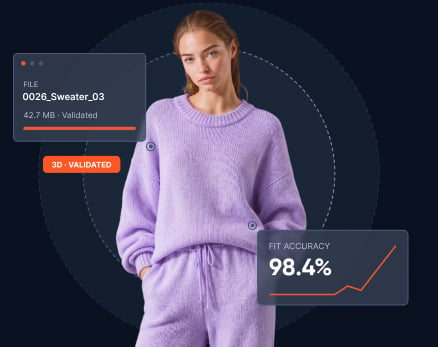
More brand clients are going digital - and they are sending files your production team has never seen before. Without a framework for what those files contain and how to route them, the result is delay: rework requests, extra sampling rounds, and stalled development cycles. When apparel brands run a digital workflow, manufacturers typically receive .bw, .u3ma, and tech pack-embedded 3D files - and those built on Browzwear's platform arrive production-validated, allowing factories to eliminate the first one to two physical sampling rounds.
Why This Is Happening Now
Brands using mature 3D platforms are now generating files that carry construction data, fabric simulation parameters, and fit validation results - the same information previously locked inside physical samples. This is not creative visualization. It is production input.
Brands using mature 3D platforms can reduce physical sample rounds by up to 80%. But that reduction only materializes if the factory on the receiving end can interpret, validate, and action those files. If your team lacks that capability, the time savings land entirely with the brand. Your side of the equation stays the same.
The Files That Arrive: A Practical Guide
Here is what your production team is likely to encounter, what each file type contains, and what you need to do with it.
Step 1: Identify the File Type Before Routing
Not all digital files are equal. Some contain simulation data; others are export formats for specific downstream steps. The most common file types arriving from brands on a 3D workflow are:
- .bw (Browzwear project file): The native format from Browzwear's VStitcher platform. Contains the full 3D garment - pattern pieces, seam data, fabric assignments, colorways, and simulation parameters. Every construction decision is embedded and traceable. This is the highest-fidelity format you will receive.
- .u3ma (Universal 3D Material Archive): A fabric and material file format. Contains physical simulation properties - weight, stretch, drape behavior - calibrated against actual fabric swatches. When a brand sends a .u3ma alongside a garment file, they are giving you the simulated material used in their fit validation, not a generic approximation.
- Tech pack with embedded 3D exports: A traditional tech pack augmented with 3D-generated imagery and dimension tables derived from a validated digital twin. More precise than hand-drafted tech packs because it reflects fit validation, not estimation.
- .glb / .fbx (visualization exports): Rendered mesh files for digital merchandising or sales presentations. No construction data. Treat as visual reference only - not production-ready.
Step 2: Validate What the File Actually Contains
Receiving a 3D file is not the same as receiving a production-ready file. Before you commit technical resources, confirm three things:
- Is the garment file matched to calibrated fabric data? A simulation without accurate material properties will not reflect real-world fit. If a .bw file arrives without a corresponding .u3ma, request it before proceeding.
- Has the file been fit-validated by the brand? Ask explicitly. A production-validated file has been checked against the approved size spec on a calibrated digital avatar. An early-stage file has not - and that determines whether you can eliminate your first sampling round.
- Does the pattern data align with your production tolerances? Cross-reference key dimensions against your graded spec. Discrepancies are faster and cheaper to resolve digitally than after a physical sample is cut.
Step 3: Route Files to the Right Function
Once validated, each file type has a defined destination inside your workflow:
- .bw files go to your pattern room for construction review and marker preparation.
- .u3ma files go to fabric sourcing. The simulation properties function as a digital material brief defining what the physical fabric must match.
- Augmented tech packs go through standard intake, with 3D imagery used as fit reference to reduce ambiguity during costing and first-sample preparation.
- Visualization-only exports (.glb, .fbx) remain with client services as commercial reference. They do not feed into production.
Step 4: Establish a Shared File Standard With Brand Clients
The most efficient manufacturers define a clear intake standard with each brand client upfront: which formats they accept, what validation confirmation they require before reducing sampling rounds, and what happens when files arrive incomplete. A one-page digital file intake protocol - agreed at project kick-off - eliminates the ambiguity that drives rework requests on both sides.
From File to Production: What Changes When Files Are Production-Validated
| Browzwear Capability |
Operational Change |
Business Outcome |
| Production-validated digital twins |
Pattern, material, and fit data arrive verified against approved spec - no reconstruction required |
First one to two physical sampling rounds eliminated per style |
| Calibrated fabric simulation (.u3ma) |
The sourcing team receives a digital material brief with defined physical properties |
Fabric approval cycle shortened; fewer substitution iterations before first cut |
| 3D-augmented tech packs |
Fit reference imagery replaces ambiguous hand-drafted callouts |
Fewer clarification requests from the production team; costing accuracy improves |
How a Digital-Ready Manufacturer Processes a Brand Order
When a brand running Browzwear sends files to a production-ready manufacturer, the workflow compresses in a repeatable way. The brand delivers a .bw garment file, .u3ma fabric files, and a validated tech pack at order placement - not after a first physical sample. Your technical team cross-checks pattern dimensions and seam construction against your production standards and flags discrepancies before any cutting begins.
If the file arrives production-validated - fit confirmed against an approved spec - your first physical sample reflects construction decisions already resolved digitally. For manufacturers processing 200 or more styles per season, that distinction is the difference between a manageable workload and a capacity ceiling.
Addressing the Readiness Question Directly
Does adopting digital file intake require retraining the entire production team? No. The core capability is concentrated in two functions: your pattern room and your technical design team. Training them to open, validate, and cross-reference 3D garment files extends an existing skill set rather than replacing it. A focused two-to-three-day onboarding on file types and validation workflows is typically sufficient for technical staff to process incoming .bw and .u3ma files independently.
What if brand clients are not yet sending production-validated files? Define what you need from each brand client to reduce sampling rounds - file format, validation confirmation, fabric data - and build that into your order intake. Manufacturers who specify digital-ready requirements signal capability that generic CMT competitors cannot match.
Frequently Asked Questions
- Q: What is a .bw file?
- A: A .bw file is the native project format from Browzwear's VStitcher platform. It contains the complete 3D garment - pattern pieces, seam relationships, fabric assignments, and simulation data. It is the highest-fidelity file format a brand can send to a manufacturer for production use.
- Q: What does "production-validated" mean for a 3D garment file?
- A: A production-validated file has been fit-checked against an approved size specification on a calibrated digital avatar by the brand. Receiving one allows a factory to eliminate the first one or two physical sampling rounds, since construction decisions have already been resolved digitally.
- Q: What is the difference between a .glb file and a .bw file?
- A: A .glb file is a visualization export used for sales tools and digital merchandising. It carries no construction or simulation data. A .bw file is a full project file with pattern, material, and fit data. Only .bw files are production-ready inputs; .glb files are commercial reference only.
Key Takeaways
- When apparel brands run a digital workflow, manufacturers typically receive .bw, .u3ma, and tech pack-embedded 3D files - and those built on Browzwear's platform arrive production-validated, allowing factories to eliminate the first one to two physical sampling rounds.
- Not all digital files are production-ready. Visualization exports (.glb, .fbx) do not include construction data and belong in client services, not the pattern room.
- The four-step intake framework - identify, validate, route, and standardize - gives production teams a repeatable process for handling any digital file type without disrupting existing workflows.
- Readiness is concentrated in two functions: pattern room and technical design. Targeted training on file types and validation steps closes the gap without a full workflow overhaul.
- Digital file capability is becoming a commercial differentiator. Brands standardizing on digital-first development evaluate production partners on the ability to receive and action those files - not just cut and sew.
Ready to See It in Your Workflow?
Manufacturers using Browzwear are processing more styles per season with fewer sampling rounds - and winning clients who require digital-first workflows. See what that looks like in practice.